


2023 has been a rollercoaster ride for the Indian stock market, a year marked by resilience, surprises, and ultimately, another year of positive returns. Let’s take a deep dive into each month’s performance, the key factors at play, and how the Indian market fared in comparison to its global counterparts.
January: Setting the Stage for Growth
The year started cautiously, with the Sensex gaining a modest 2.5%, as investors awaited clarity on several fronts – global inflation, the Ukraine war, and the upcoming Union Budget. The budget, however, brought relief with its focus on infrastructure spending and fiscal consolidation, propelling the market further.
February: Bumpy Road Ahead
Worries about rising interest rates in the US and geopolitical tensions caused a correction in February, with the Sensex falling 3.1%. However, strong corporate earnings and positive data on domestic consumption provided support, limiting the downside.
March: Budget Blues
The market remained choppy in March, digesting the implications of the Budget and its potential impact on specific sectors. The Sensex ended the month with a slight gain of 0.7%, highlighting the cautious optimism despite lingering concerns.
April: Finding its Footing
April saw a resurgence as strong quarterly results from key sectors like IT and financials boosted investor confidence. The Sensex climbed 5.4%, signaling a return to optimism and a belief in the Indian growth story.
May: Season of Scepticism
May brought the “Sell in May” theory into play, with the Sensex declining 2.8%. Global headwinds, fears of a recession, and a weaker rupee weighed on sentiment. However, the fall was mitigated by the government’s proactive measures to manage the currency and attract foreign investment.
June: Finding Equilibrium
June saw a steady consolidation as the market attempted to find its footing amidst mixed global cues. The Sensex gained a marginal 0.3%, reflecting a cautious wait-and-see approach from investors.
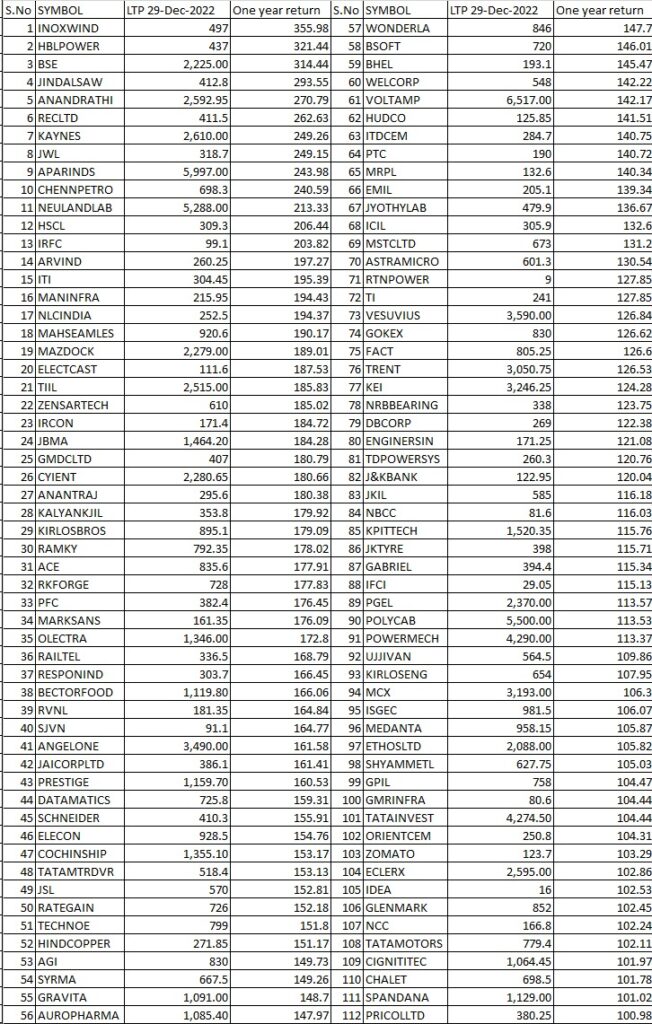
Nifty total market cap index has 750 stocks out of which 112 stocks gave returns of over 100% this year.
July: Monsoon Magic
A good monsoon season lifted spirits in July, leading to the Sensex rising 4.2%. Positive data on rural demand and expectations of a boost to agricultural produce further fueled the rally.
August: Earnings Drive
Strong corporate earnings across various sectors continued to be the driving force in August, with the Sensex gaining 5.9%. The market also cheered the government’s focus on infrastructure development and privatization initiatives.
September: Fading Momentum
Profit-booking ahead of the festive season and concerns about global growth resulted in a slight dip in September, with the Sensex falling 1.7%.
October: Festive Cheer
The festive season brought back the buying spree, propelling the Sensex up 7.2%. Increased retail participation and positive sentiment surrounding Diwali festivities contributed to the surge.
November: Consolidation Phase
After the October rally, November saw a period of consolidation with the Sensex gaining a modest 0.9%. Investors awaited further cues from global markets and the upcoming December quarter earnings season.
December: Year-End Highs
The year ended on a high note, with the Sensex surpassing its all-time high and finishing with a gain of 8.5%. Strong FII inflows, robust economic data, and optimism about the upcoming Union Budget fueled the December rally.
Global Comparison: A Tale of Two Speeds
While the Indian market outperformed several developed markets in 2023, it lagged behind some. Compared to the Dow Jones’ gain of 5.6% and the S&P 500’s rise of 8.8%, the Indian market’s performance was respectable but not exceptional. However, factors like strong domestic fundamentals, a young and growing population, and government reforms position India for a potentially stronger run in the coming years.
2024: A Promising Horizon?
Looking ahead, several factors will influence the Indian market in 2024. Global economic conditions, interest rate movements, geopolitical developments, and domestic policy decisions will play a key role. Nonetheless, several factors bode well for India:
- Strong domestic fundamentals: Robust domestic consumption, infrastructure spending, and a focus on manufacturing are expected to drive growth.
- Corporate earnings momentum: Strong corporate earnings, particularly in IT and financials, are likely to continue.
- Rising foreign investment: India’s attractiveness as an investment destination is increasing, leading to higher FII inflows.
- Union Budget expectations: The upcoming Union Budget is expected to further boost growth and investor confidence.
Sectors Poised to Shine:
- IT & Technology: The digital wave continues, making IT stocks prime contenders for continued growth. Cloud computing, cybersecurity, and AI-driven solutions will be hot areas.
- Infrastructure & Renewables: Government focus on infrastructure development and green energy initiatives will benefit construction, engineering, and renewable energy companies.
- Healthcare: Rising healthcare spending and an aging population bode well for pharmaceuticals, diagnostics, and medical equipment players.
- FMCG & Consumer Staples: Rising disposable incomes and rural demand will likely boost FMCG giants and retailers catering to essential goods.
- Manufacturing & Defense: PLI schemes and focus on “Make in India” could propel domestic manufacturing, particularly in defense and aviation sectors.
Policy Twists that Could Spice Up the Dance:
- Budget 2024: Tax cuts, infrastructure spending boosts, and rural development initiatives could be big catalysts.
- Monetary Policy: Interest rate movements will be crucial. Stable or lower rates could fuel optimism, while hikes could dampen sentiment.
- FPI inflows: Attracting foreign investment through policy clarity and ease of doing business will be key.
- Geopolitical Landscape: Global events and their impact on the Indian economy will need to be monitored closely.
Disclaimer: Predictions are not guarantees, and unforeseen events can disrupt even the best-laid plans. However, understanding these potential sector stars and policy drivers can help you make informed investment decisions.
Remember, diversify your portfolio, do your own research, and stay updated on market developments. Happy investing!


